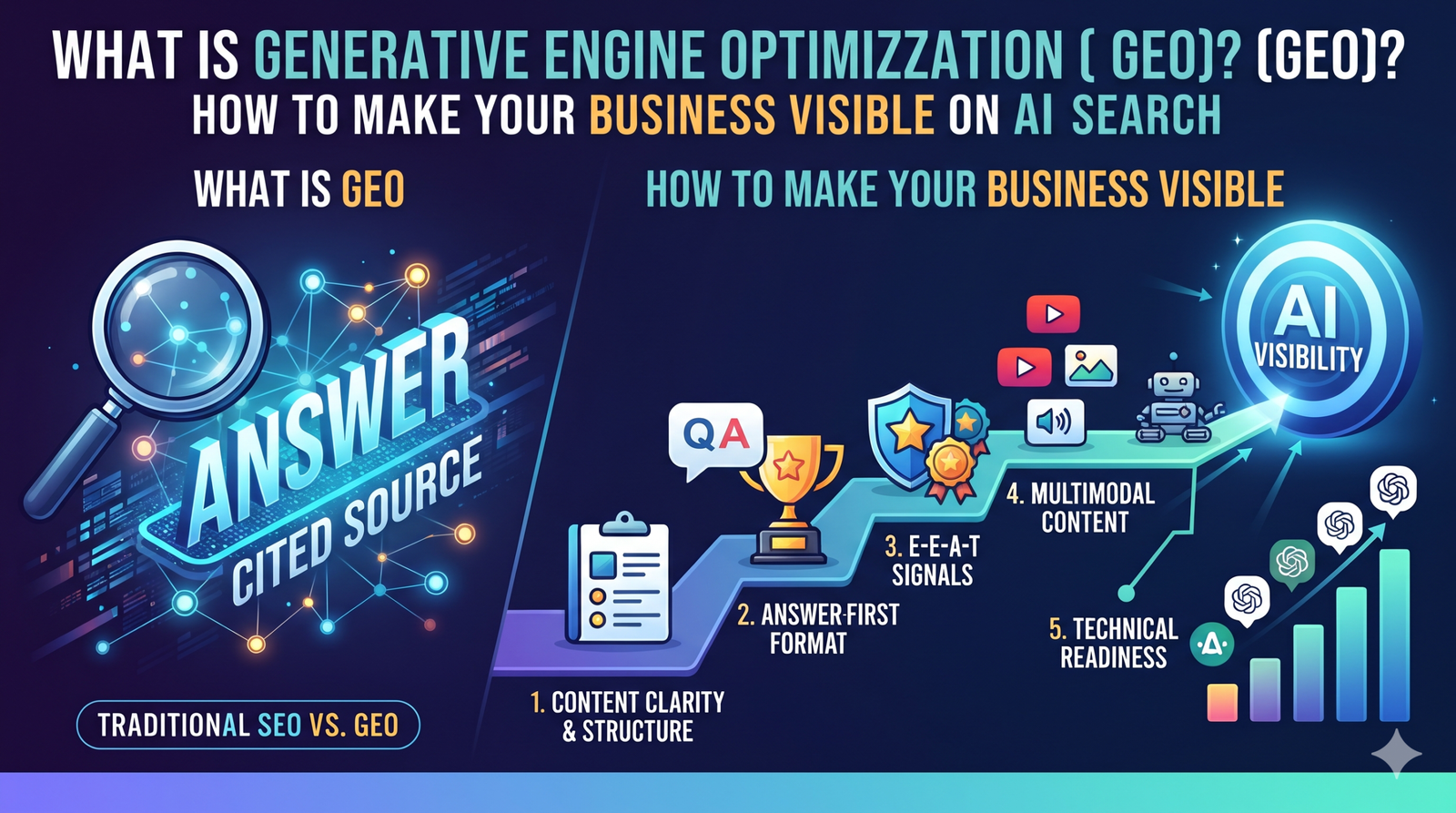
What Is Generative Engine Optimization (GEO)? How to Make Your Business Visible on AI Search
Well let me tell you, what Generative Engine Optimization can do! Imagine someone searching for a digital marketing agency in Pune. Instead of opening multiple websites and comparing services, they ask an AI assistant: “Which digital marketing agencies in Pune are suitable for small businesses?” The AI may provide a summarised answer with relevant businesses and website references.
This changing search behaviour is creating a new area of digital marketing called Generative Engine Optimization (GEO).
Traditional SEO focuses on improving a website’s visibility in search engine results. GEO focuses on improving the chances of a brand’s useful, trustworthy information being discovered, understood, and referenced in AI-powered search experiences.
For business owners, marketers, website developers, and students, understanding GEO is becoming increasingly important. However, it is equally important to understand what GEO can and cannot do.
1. What Is Generative Engine Optimization (GEO)?
Generative Engine Optimization is the practice of improving online content and brand information so that AI-powered search experiences can discover, understand, and potentially reference it when answering users’ questions.
These experiences include AI-powered search features and conversational search tools.
For example, a user might ask:
- Which are the best digital marketing agencies for small businesses in Pune?
- How can I promote my home bakery online?
- What should I check before hiring a website designer?
- Which graphic design course is suitable for beginners?
An AI-powered search experience may generate an answer by gathering and interpreting information from different sources.
GEO aims to make your website and brand information useful, clear, credible, and relevant enough to be considered in these experiences.
Important: GEO does not guarantee that an AI tool will mention your business. No agency or SEO professional can honestly promise that a website will always appear in ChatGPT or Google’s AI-generated answers.
2. GEO vs Traditional SEO: What Is the Difference?
GEO and SEO are connected, but they are not exactly the same.
Traditional SEO focuses on improving a website’s visibility in search engines such as Google. GEO focuses on visibility within generative AI experiences that may provide direct, conversational answers.
| Traditional SEO | Generative Engine Optimization |
|---|---|
| Focuses on search engine visibility | Focuses on AI-powered answer visibility |
| Targets search queries and keywords | Addresses questions, context and user intent |
| Improves website structure and content | Makes information clear, useful and understandable |
| Aims to attract relevant search traffic | Aims to improve the chance of being discovered or referenced |
| Uses tools such as Google Search Console | Requires monitoring relevant AI search experiences as well |
Does GEO replace SEO? No.
Google’s guidance explains that its AI search features continue to rely on the foundations of Google Search. Good technical SEO, helpful content, crawlability and a strong user experience remain important.
Therefore, businesses should not abandon traditional SEO to follow GEO trends. They should strengthen their existing SEO strategy while adapting to changing search behaviour.
3. Why Is GEO Becoming Important for Businesses?
People increasingly use conversational AI tools to research products, understand services, compare options and find solutions.
This creates another opportunity for businesses to become discoverable.
Consider a small business selling customised gifts in Pune.
Earlier, a customer might search Google for “customised corporate gifts in Pune”. Today, that customer may also ask an AI assistant:
“Where can I order personalised corporate gifts in Pune for 50 employees?”
The business needs more than a social media page. Its website should clearly explain:
- What products and services it offers.
- Which locations it serves.
- Whether it handles bulk orders.
- What customisation options are available.
- How customers can contact the business.
- What makes its service different.
When this information is clearly available online, it becomes easier for people and search systems to understand the business.
GEO is not just for large companies. Local businesses, freelancers, consultants, educational institutions and service providers can also benefit from building a reliable online presence.
4. How Does AI Search Discover and Use Website Content?
AI-powered search experiences can use information from indexed web pages and other sources to generate responses.
The exact process differs between platforms, but the following concepts help explain it.
Crawling: Search systems discover publicly accessible website pages.
Indexing: Search engines process and organise eligible content so that it can be considered for search.
Understanding: Systems interpret the page’s subject, context, relevance and usefulness.
Retrieval and response generation: Depending on the platform, relevant information may be retrieved and used to generate an answer, sometimes with links to supporting sources.
This is why a website should not contain only attractive images and promotional slogans. It should also provide clear, meaningful information.
For example, compare these two website descriptions:
Unclear description:
“We are the best service provider offering excellent solutions for everyone.”
Clear description:
“We provide website design, social media marketing, local SEO and Google Business Profile management for small businesses in Pune.”
The second description explains exactly what the business does and whom it serves.
5. How to Improve Your Website for Generative Engine Optimization
There is no guaranteed GEO formula. However, several practical improvements can strengthen your website’s overall search visibility and usefulness.
A. Publish Helpful and Original Content
Create content that answers genuine questions from your audience.
For example, a website designing company can publish articles such as:
- How Much Does Website Development Cost in India?
- What Pages Should a Small Business Website Have?
- How to Choose a Website Design Company?
- Why Is My Website Not Generating Leads?
Avoid publishing dozens of similar articles simply to target different keyword variations.
Each article should offer a useful explanation, practical examples or genuine professional insight.
B. Use Clear Headings and Content Structure
Organise your articles with descriptive headings and subheadings.
For example:
- What Is Local SEO?
- Why Is Local SEO Important?
- How Can Small Businesses Improve Local SEO?
- Common Local SEO Mistakes
This structure helps readers understand the topic and makes the page easier to navigate.
Use short paragraphs, relevant lists and meaningful examples. Do not force keywords into every heading.
C. Demonstrate Experience and Expertise
A website should demonstrate why visitors should trust its information.
You can strengthen credibility by including:
- Author details and professional experience.
- Real project examples.
- Case studies and practical demonstrations.
- Accurate business contact information.
- Genuine customer testimonials and reviews.
- Updated service and pricing information where appropriate.
For example, a digital marketing trainer can explain a local SEO strategy using a sample business profile and demonstrate how the improvements were made.
First-hand experience adds value that a generic AI-generated article may not provide.
D. Maintain Consistent Business Information
Your business name, address, phone number, website and service information should be accurate and consistent across important online platforms.
For a local business, pay attention to:
- Google Business Profile.
- Official website.
- Business directories relevant to your industry.
- Professional social media profiles.
- Genuine customer review platforms.
Avoid creating fake listings or purchasing artificial reviews.
E. Improve Technical SEO
A technically weak website can create problems for users and search engines.
Check the following:
- Is your website accessible to search crawlers?
- Are important pages indexed?
- Does your website work properly on mobile devices?
- Are pages loading quickly?
- Are there broken links?
- Are page titles and meta descriptions relevant?
- Is your website using HTTPS?
- Is the navigation easy to understand?
Use Google Search Console to monitor indexing and search performance.
F. Use Structured Data Where Relevant
Structured data is a way of describing information on a webpage using a recognised format.
For example, relevant schema types may include:
- Organization
- LocalBusiness
- Article
- BreadcrumbList
- Product, where applicable
Structured data can help search engines interpret page information and may support eligibility for certain search features.
However, schema markup does not guarantee a higher ranking or an AI-generated recommendation. Use only accurate and relevant structured data.
6. GEO Strategies for Different Types of Businesses
GEO becomes easier to understand when we look at practical examples.
For a digital marketing agency: Publish service pages explaining SEO, social media marketing, website development and lead generation. Add genuine case studies and explain the process behind your services.
For a home bakery: Clearly mention the products, delivery locations, order process, customisation options and contact details. Publish helpful content about cake ordering, ingredients and event requirements.
For a home tutor: Explain the subjects, classes, teaching format, location and learning approach. Answer common questions parents ask before selecting a tutor.
For a graphic designer: Display a portfolio, explain design services and share practical articles about branding, logo design, social media creatives and visual identity.
The principle is simple: make your business information useful and easy to understand.
7. GEO Tools That Digital Marketers Should Know
You do not need an expensive GEO tool to begin improving your website.
Start with these resources:
Google Search Console: Monitor indexing, search queries, impressions and clicks.
Google Analytics 4: Understand website traffic and user behaviour.
Google Business Profile: Maintain accurate business information and monitor customer interactions.
ChatGPT and Gemini: Research audience questions, identify content gaps and organise content ideas. Verify factual information before publishing.
SEO platforms: Tools such as Semrush and Ahrefs can support keyword research, competitor analysis and backlink research.
You can also manually test relevant questions in different AI search experiences. Record whether your business or website appears, which sources are referenced and what information may be missing.
Remember that these checks are indicative, not a guaranteed measurement of GEO performance.
8. Common GEO Mistakes Businesses Should Avoid
As GEO becomes popular, many businesses may be tempted to follow shortcuts. Avoid these mistakes:
- Ignoring traditional SEO: GEO does not make technical SEO, keyword research or useful website content irrelevant.
- Publishing AI-generated articles without editing: Unverified, repetitive content can damage credibility and provide little value.
- Keyword stuffing: Repeating the same keyword unnaturally does not create a better user experience.
- Buying fake reviews or mentions: Artificial reputation-building can mislead customers and create long-term risks.
- Believing every GEO ranking claim: Be cautious of anyone promising guaranteed AI recommendations.
- Ignoring website experience: A confusing, slow or outdated website can discourage visitors even if they discover it through AI search.
Google also advises website owners to focus on original, people-first content rather than producing large quantities of low-value pages using automation.
9. Is GEO a Good Career Opportunity for Digital Marketing Students?
Yes, GEO is a useful emerging area for digital marketing students to understand.
However, students should not treat GEO as a replacement for learning SEO.
A strong foundation should include:
- Keyword research and search intent.
- On-page and technical SEO.
- Content strategy and writing.
- Website structure and basic HTML.
- Google Search Console and Analytics.
- Local SEO and Google Business Profile.
- AI-assisted research and content workflows.
- Performance analysis and reporting.
Students can build a practical portfolio project by selecting a small business, analysing its website, identifying content gaps, improving its service pages and creating a content strategy.
They can then document the work and explain how the changes support both traditional search visibility and discoverability in AI-powered search experiences.
This is more valuable than simply claiming to know GEO.
10. What Is the Future of GEO?
Search behaviour is evolving. People are exploring conversational search, AI-generated summaries and tools that help them compare information faster.
Businesses will need to focus on clear communication, trustworthy information, strong websites and meaningful customer experiences.
At the same time, traditional SEO will continue to provide an important foundation.
The most practical strategy is not to choose between SEO and GEO. It is to create a strong digital presence that serves real customers and can be understood across different discovery platforms.
Frequently Asked Questions (FAQs)
1. What is Generative Engine Optimization (GEO)?
Generative Engine Optimization is the practice of improving online content and brand information so that AI-powered search experiences can discover, understand and potentially reference it.
2. Is GEO replacing traditional SEO?
No. GEO complements SEO. Technical SEO, helpful content, website structure and search visibility remain important.
3. How can a small business improve its GEO?
A small business can publish useful content, maintain accurate business information, improve its website, build credibility and answer customer questions clearly.
4. Does ChatGPT recommend businesses based on GEO?
AI tools may use publicly available information and other sources when answering business-related questions. However, there is no guaranteed method to make a business appear in every answer.
5. Is GEO important for local businesses in India?
Yes. Local businesses can benefit from maintaining accurate service details, location information, helpful website content and a trustworthy online presence.
6. Should digital marketing students learn GEO?
Students should understand GEO alongside SEO, content marketing, analytics and local search. These foundational skills are useful for adapting to changing search experiences.
Conclusion
Generative Engine Optimization represents an important development in how businesses think about online visibility. As customers explore AI-powered search experiences, businesses need to make their information clear, accurate, useful and trustworthy.
However, there is no shortcut to becoming visible in AI search. A strong website, quality content, technical SEO and genuine business credibility remain the foundation.
For digital marketers and students, this is an opportunity to expand their knowledge and understand how search marketing is evolving.
At Vocabulix, we believe that learning digital marketing means understanding not only today’s tools but also the changes shaping tomorrow’s online world.